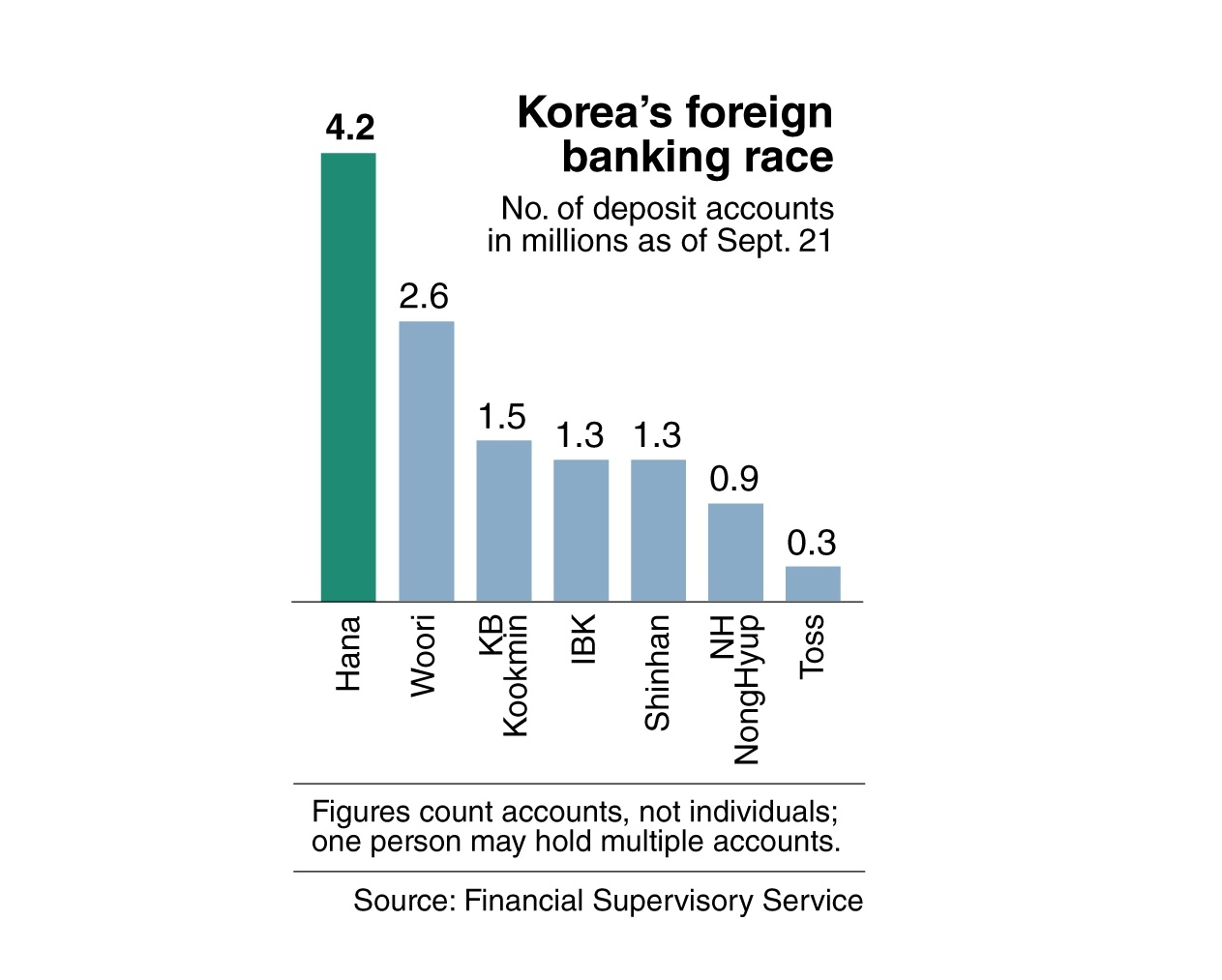
Exclusive FSS data shows Hana with 4.2 million foreign-held accounts, ahead of Woori's 2.56 million and KB Kookmin's 1.49 million, as banks vie for new customers
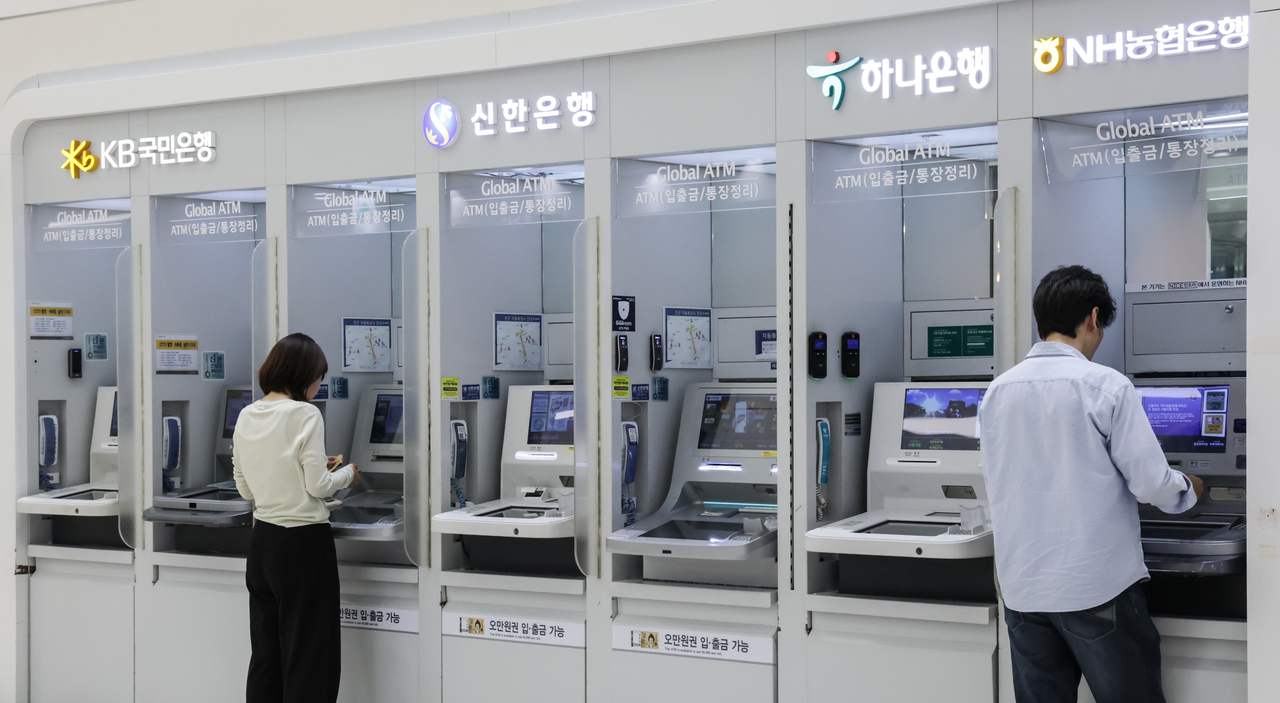
Hana Bank has emerged as the clear leader in deposit accounts held by foreign nationals in South Korea, according to exclusive regulatory data offering a glimpse into how lenders are positioning themselves in the country's expanding foreign banking market.
Hana held 4.2 million deposit accounts belonging to foreign individuals as of Sept. 21, far ahead of Woori Bank's 2.56 million, according to Financial Supervisory Service data obtained by People Power Party Rep. Park Sung-hoon and shared exclusively with The Korea Herald on Tuesday.
KB Kookmin Bank ranked third with 1.49 million accounts, followed by Industrial Bank of Korea with 1.32 million and Shinhan Bank with 1.3 million. NH NongHyup Bank had about 877,000 accounts and Toss Bank about 321,000.
The figures count deposit accounts rather than individual customers, meaning one person may hold multiple accounts. While they do not directly measure customer market share, they offer a snapshot of banks' relative positions in an increasingly competitive market.
The rankings come as Korea's foreign population continues to grow, creating new business opportunities for lenders. The country had 2.87 million foreign nationals staying in Korea at the end of August, up 5.3 percent from a year earlier, according to the Ministry of Justice. Of those, 2.25 million were long-term residents.
For banks, deposit accounts are often the starting point for broader customer relationships, opening opportunities to offer overseas remittances, payments and other financial services as foreign residents establish their lives and careers in Korea.
Personal touch remains key
The competition highlights the continued importance of personal contact in an increasingly digital banking industry.
Hana, which operates 17 specialized branches offering Sunday services, said face-to-face assistance remains central to its strategy. The bank also hires foreign staff to help customers overcome language barriers and navigate Korea's financial system.
"Given the difficulties customers face with language and a financial environment different from their home countries, we aim to handle initial transactions face to face and subsequent transactions, such as overseas remittances and transfers, digitally," a Hana official said.
Woori, which ranked second, also credited specialized branches and Sunday banking as major factors in attracting foreign customers.
"Many foreign customers find it difficult to visit a bank during the work week. Offering services on Sundays and communicating in their native languages has helped us attract customers," a Woori official said.
The bank added that customers unfamiliar with Korean may prefer in-person services because they worry about making mistakes when navigating mobile banking applications.
Other lenders are strengthening services for foreign customers even as Korea's overall bank branch network shrinks. The number of outlets operated by 16 banks fell by 111 to 5,514 last year, according to Korea Federation of Banks figures reported in March.
Shinhan expanded Sunday banking for foreign customers to include branches in Busan and Daegu in April, while NH NongHyup introduced dedicated service desks at three branches last October, using translation technology supporting 38 languages.
Digital banks join the race
Meanwhile, digital accounts are emerging as another competitive front.
According to the FSS submissions, KB Kookmin, Shinhan and Toss allow eligible foreign applicants to immediately open accounts through mobile channels. Woori requires a one-day approval process, while Hana requires customer service center approval during business hours.
Hana said mobile transactions among foreign customers have increased significantly and that it plans to simplify procedures to encourage greater digital use.
Internet-only lenders are also entering the market. Earlier this month, Kakao Bank launched services for foreign residents, offering account opening, debit cards and overseas remittances through its app, with support in English, Chinese and Vietnamese.
As Korea's foreign population grows, deposit account holdings offer one indication of which banks have established a foothold in the expanding market — and how much ground newer competitors may have to cover.
jwc@heraldcorp.com